How to Clean a Barong Tagalog: Piña, Jusi and Other Fabrics
Care for a barong by checking its maker’s instructions, fabric and embroidery before washing, drying, pressing or booking specialist cleaning.
Clean a barong according to the instructions for that particular garment, not a universal rule for “piña” or “jusi”. Check the maker’s directions, embroidery, lining and condition before wetting it. If the instructions are missing, contradictory or unsuitable for the equipment you have, ask the maker or an experienced cleaner to assess it first.
A wedding barong, an everyday uniform and an inherited embroidered piece may need different handling. This guide explains the decisions to make before washing and the information to give a cleaner. It does not replace the maker’s instructions with a single home-cleaning recipe.
Identify the garment beyond its fabric name
Find the sewn-in label and any care card supplied with the barong. Photograph both so you can refer to them when asking for advice. Look for the stated fibre composition, lining, permitted cleaning method and instructions about drying, heat or steam.
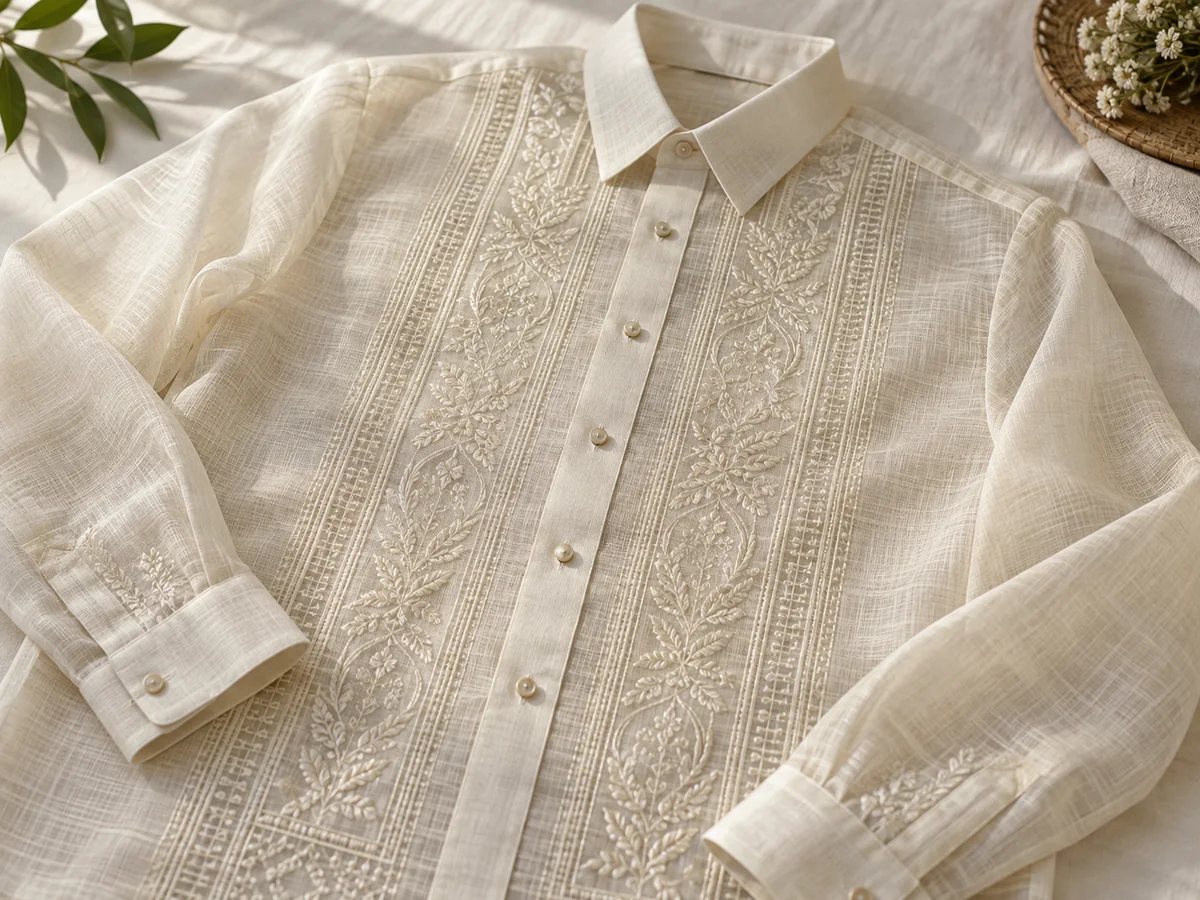
Describe the embroidery and other construction details as well. A cleaner needs to know about decorative panels, stiffened areas, unusual fastenings and existing repairs. Do not assume a seller’s fabric name tells you every material used in the finished garment.
If the piece was custom made, contact the maker with the order details. If it was borrowed, obtain the owner’s instructions before taking it to a shop. A rented garment may have a return-and-cleaning procedure that you should follow rather than attempting treatment yourself.
For a fragile heirloom, loose embroidery or fabric that already appears weakened, avoid experimenting to determine what it can withstand. Describe the condition and ask whether specialist textile care is needed. An ordinary laundry intake is not the same as a conservation assessment.
Why online barong instructions can conflict
Maker guidance is not uniform. Heritage Barong describes hand washing and distinguishes handling by fabric, while also suggesting professional help when necessary. MyBarong warns against machine washing and routine dry cleaning for specified embroidered jusi and piña garments, allowing only an appropriate specialist process.
Those pages concern their products and advice. They do not establish that every barong should receive either ordinary hand washing or solvent cleaning. Where the recommendations differ, the sensible next step is to ask the maker of your garment which instruction applies.
The American Cleaning Institute’s explanation of professional-only labels also shows why construction and trims matter alongside the main fabric. A garment can need special handling for reasons that are not obvious from its appearance.
Avoid combining the most forceful parts of several online recipes. A soaking suggestion from one maker, a brushing technique from another and a heat setting from a third do not form a verified process for your barong.
Inspect it before any treatment
Lay the dry garment on a clean surface and examine the collar, cuffs, underarms, seams and embroidery. Note the location of marks without assuming that every yellow area has the same cause. Existing discolouration, residue and fabric damage require different assessments.
Write down what happened if you know: a drink spill, a food mark or a long period in storage. Include when the mark appeared and anything already applied. A clear photograph in neutral light can help the maker advise whether to inspect it in person.
Remove only accessories that are intended to be detached. Do not pull at embroidery or dismantle parts of the garment to prepare it for a wash. If you find a loose button or open seam, ask whether it should be repaired before cleaning.
If the barong is needed for an event, disclose the deadline at the first enquiry. Leave time for assessment, processing and inspection. An urgent deadline does not make an uncertain method safer.
Ask the maker a question it can answer
“Can I dry clean a barong?” is too broad when several fabrics and constructions share that name. Send the maker the specific product or order reference, a full-garment photograph, the label and a close view of the problem. Explain whether the piece has been cleaned before and whether the current care card belongs to this exact garment.
Ask for a complete sequence: approved cleaning method, suitable product type, drying support, and permitted heat or steam for finishing. If its reply says “take it to a dry cleaner”, clarify whether it means professional assessment or a particular solvent process. The name of the shop does not define the treatment it should use.
One useful follow-up is: “Does this instruction cover the embroidered areas and lining as well as the main fabric?” This avoids applying advice for a fabric sample to a finished garment with different components.
Keep the answer with the barong and share it with the receiving cleaner. If the cleaner proposes a different method, ask it to explain the reason before agreeing. For a borrowed piece, send that proposal to the owner rather than deciding on their behalf. Resolving the method in writing gives everyone the same reference when the garment is handed over, finished and returned.
If the maker permits hand washing
Follow the maker’s exact method for detergent, water temperature, soaking and movement. Prepare a clean basin large enough to support the garment without crowding it. Keep the instructions beside you so you do not have to improvise halfway through.
Both Heritage Barong and MyBarong advise against twisting or squeezing their specified garments during rinsing. That is a useful warning against treating delicate formalwear like a sturdy towel. Support the item as directed and avoid pulling on wet sleeves or embroidered areas.
Do not assume brushing is acceptable. The maker pages distinguish between fabric types and embroidery; a technique mentioned for one version may be inappropriate for another. If you are uncertain about a stain, leave it for assessment instead of escalating from gentle movement to hard scrubbing.
Stop if the treatment produces unexpected colour release, distortion or visible stress. Rinse or otherwise respond only as the product and garment instructions direct, and seek advice about the next step. Repeating an uncertain treatment is not a reliable way to rescue a delicate piece.
This conditional approach means some barongs will never enter your home-wash routine. That is a reasonable outcome when the instructions or condition do not support it.
Drying and finishing need their own instructions
Washing permission is not permission to tumble dry. Read the drying directions before you begin, and make sure you have an appropriate clean support and space. Keep the garment away from surfaces or accessories that could mark it.
Follow the recommended shape and support during drying. Do not stretch the fabric to force it back into place or assume that a hard crease can be removed with stronger pulling. If the maker’s drying method is impractical in your home, arrange professional handling before washing.
For pressing, use only the heat, steam and protective method the maker permits. A familiar iron setting is not proof that it is suitable for an unfamiliar barong. Ask about hand finishing where needed, rather than giving a cleaner a vague instruction to make the piece “very crisp”.
Do not add starch by default. If a particular finish matters, describe the desired appearance and ask what is appropriate for the garment. Photographing how it originally looked can help communicate the request without specifying an unverified treatment.
Store it after cleaning and complete drying
Confirm that the whole garment is dry before storing it. Follow its support and cover instructions and choose a clean location where it will not be crushed among heavily packed clothes.
MyBarong recommends a breathable cloth cover for its specified garments rather than prolonged plastic covering. Treat that as maker guidance, and check the storage recommendation for your own piece. Packaging used for transport is not automatically the best long-term storage method.
Keep the care card, maker contact and cleaning record together. If another family member later arranges care, those details are more useful than remembering that “it went to the dry cleaner once”. Record the actual approved method when the provider supplies it.
What to ask a professional cleaner
Provide the label, fabric description, embroidery details, known damage and treatment history. Ask whether the cleaner accepts that exact construction, what method it proposes and whether it needs maker confirmation before proceeding.
WeClean’s Dry Cleaning page is a starting point for an enquiry, not a guarantee that every barong is suitable for the same process. Contact WeClean with photographs and ask about assessment before booking or packing the garment with everyday laundry.
If you are choosing between ordinary laundry and specialist handling, read the cleaning-method comparison. For a barong, the best next step is the one supported by its actual instructions and condition, even when that means pausing to ask its maker.