Dry Cleaning vs. Laundry: Which Service Do Your Clothes Need?
Choose between ordinary laundry, dry cleaning and professional wet cleaning using garment labels, construction and the finish your clothes need.
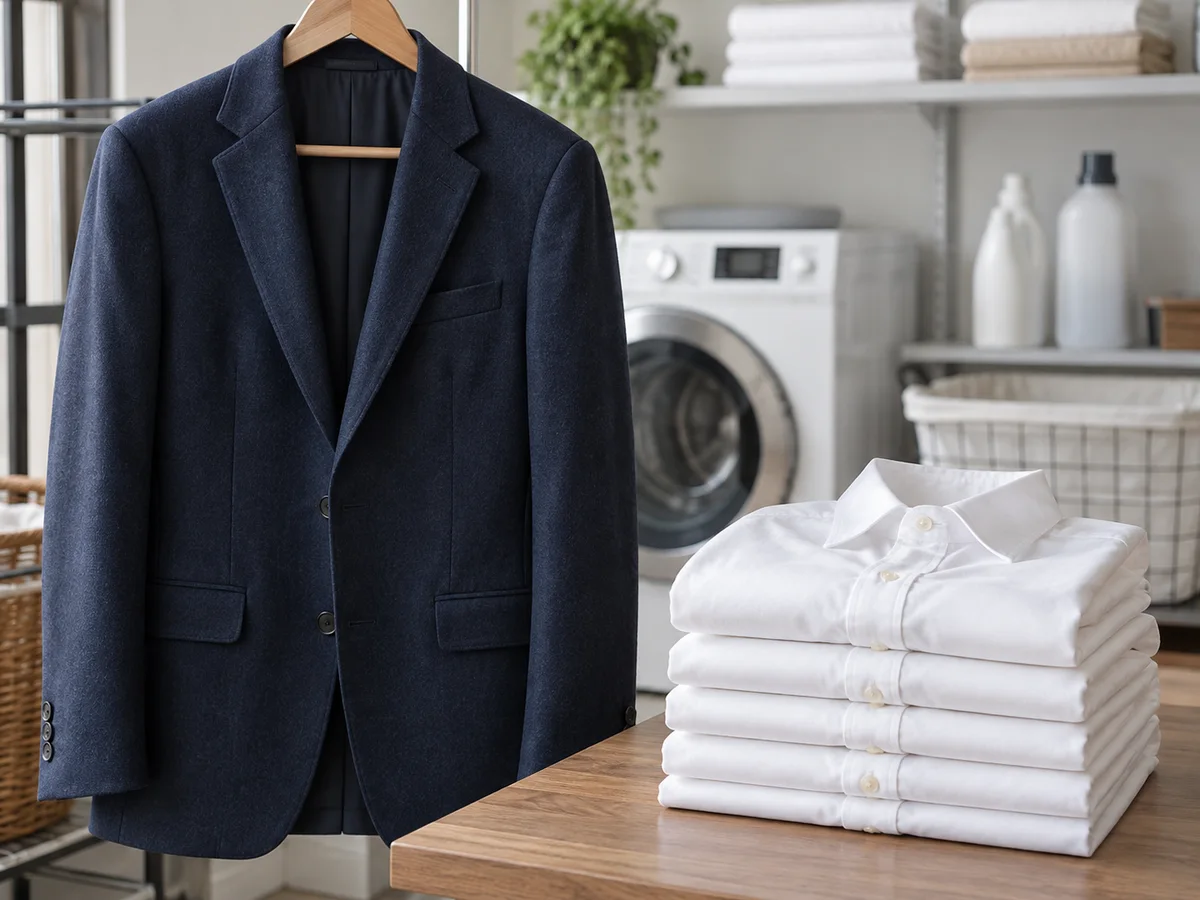
Choose the cleaning method from the garment’s care instructions and construction, then decide the finish you want. Ordinary laundry uses water and detergent. Dry cleaning uses a cleaning solvent. Professional wet cleaning is a controlled water-based specialist process; it is not simply a delicate cycle on a home washer.
An expensive item does not automatically need dry cleaning, and a cotton item is not automatically machine washable. A garment includes its dyes, lining, trims and shape, not just the fibre named on the label. Those details explain why two similar-looking shirts may need different care.
Start with the complete care label
Find the care instructions before choosing a service. Read the washing, drying and finishing directions together, including written warnings. “Do not tumble dry” still matters after an item has been washed successfully. “No steam” matters when a cleaner finishes it.
The Drycleaning & Laundry Institute’s care-label guide explains that an alternative method can carry additional risk. Its discussion of labelling law concerns the United States; the useful point for a Philippine customer is to give the cleaner the original instructions and discuss uncertainty rather than guessing.
If the label has faded, photograph what remains and look for the product’s original care information. A purchase confirmation may help identify the exact garment. Do not substitute an instruction for another shirt from the same brand: similar designs can use different fabrics and trims.
Our laundry-symbol guide explains how to turn a label into a complete care plan. Keep that plan with the garment when it needs different handling from the rest of the order.
Understand the three cleaning routes
Ordinary laundry
This is the familiar wash-and-rinse route for garments whose labels permit the available water-based process. It can be done at home or by a laundry service. The correct cycle, temperature, product and drying method still depend on the items.
A full-service wash is convenient for compatible everyday clothing. It does not mean every piece in your wardrobe should go into the same order. A washable item with a special drying instruction needs confirmation that the service can maintain that instruction through to return.
Dry cleaning
Dry cleaning is a professional cleaning route using solvent rather than an ordinary water wash. The name does not mean that the garment is merely aired or steamed. The cleaner needs to consider both the care label and any stains or construction issues before accepting it.
Avoid selecting it solely because a garment looks formal. Some formal pieces have maker-specific restrictions; others allow laundering. Equally, do not assume dry cleaning will reverse colour loss, repair worn fibres or remove every mark. Tell the cleaner which result matters and ask what is realistic.
Professional wet cleaning
GINETEX’s professional-care guidance distinguishes specialist wet cleaning from household washing. It uses controlled equipment and finishing processes that a home machine does not reproduce simply by selecting a gentle setting.
If this option is suggested, ask whether that cleaner actually offers it and why it suits your garment. WeClean’s listed dry-cleaning service should not be interpreted as confirmation that every professional cleaning process is available. Ask about the specific item and method.
Why fibre content alone is not enough
The American Cleaning Institute notes that trims, dyes and shrinkage concerns can explain a professional-only label even on a garment made largely from cotton.
Use that distinction when sorting. A plain cotton T-shirt and a cotton jacket with a lining are different finished products. Embroidery, glued decoration, contrasting panels and structured components add questions that a fibre percentage cannot answer.
Inspect the entire piece before booking. Look inside the lining for another label. Note loose buttons, weakened seams or a decorative section that has already changed appearance. If the garment is part of a matching set, mention both pieces so the cleaner can advise on maintaining a consistent appearance.
These checks are not a home test for chemical compatibility. They are a way to give a professional enough information to decide what can be accepted and what needs further assessment.
Sort a wardrobe by care requirement
Make three temporary groups: items with clear ordinary-wash instructions, items requiring professional assessment, and items with missing or conflicting information. Leave the third group out of a routine wash until the uncertainty is resolved.
Here is a hypothetical wardrobe decision. A machine-washable polo can join compatible everyday clothing. A lined jacket marked for professional cleaning needs the relevant service. A blouse with an unreadable label belongs in the assessment group, even if it feels similar to the polo.
Then decide the finish. You may want the polo folded and an eligible office shirt pressed. This is a separate choice from the cleaning method. The fold-versus-press comparison explains that second decision without treating pressing as a substitute for washing.
For a barong, start with the maker-led barong care guide. Do not use a blanket rule for every garment described as piña or jusi.
Three label details that change the booking
Some restrictions are easy to overlook when an online comparison reduces the choice to water versus solvent. Read these details before selecting a service:
| What you see | What to do next |
|---|---|
| A circle inside a square | Read it as a tumble-drying instruction, not a dry-cleaning instruction |
| A crossed professional dry-cleaning symbol | Check washing permission separately; the restriction does not automatically authorise a home wash |
| “Spot clean only” | Ask for localised assessment rather than booking whole-garment immersion |
GINETEX distinguishes the drying square from the professional-care circle. DLI explains that a spot-clean-only instruction rules out immersing or fully cleaning the garment. That restriction is particularly important when the visible mark is small but the proposed service would process the whole piece.
Consider a hypothetical decorated dress labelled “spot clean only”. Selecting a delicate machine cycle does not resolve the restriction, and requesting standard dry cleaning does not resolve it either. Send the complete label and a picture of the affected area, then ask what localised treatment can be considered and what result is realistic.
Likewise, a crossed dry-cleaning symbol on a washable shirt is not a contradiction: it can prohibit one process while the washing directions permit another. Read each care family independently, then check that the complete proposed service respects all of them. If no complete route is clear, keep the item in the assessment group.
Explain stains before processing starts
Describe where the mark is, what caused it if you know, and approximately when it happened. Mention any product already applied and whether the item has since been washed, ironed or tumble dried. If you do not know the stain’s origin, say so.
A useful handover might be: “There is a mark near the left cuff. It appeared during dinner yesterday. I have not treated it.” That gives more usable information than asking for the strongest possible clean.
Ask the cleaner to flag any proposed change from the garment’s instructions before proceeding. If stain removal and fabric preservation cannot both be assured, decide which risk you are prepared to accept. A professional assessment can still conclude that a mark should be left alone.
Avoid requesting an unqualified “deep clean” for a delicate garment. Specify the actual concern: odour, a visible mark, surface dirt or the finishing of a collar. Different concerns may require different decisions.
What to confirm when booking
Confirm acceptance, the proposed cleaning route, finishing, packaging and return date. If the item is needed for a wedding or interview, give the date at enquiry stage and leave time to inspect the result. An ordinary-laundry turnaround should not be assumed to cover specialist garments.
On return, check the item against the intake notes. Review the identified stain, buttons, seams, lining and finish. If something is unresolved, contact the cleaner with the order reference rather than immediately trying a second treatment at home.
For compatible everyday garments, explore WeClean’s Wash, Dry & Fold service. For pieces needing assessment, use the Dry Cleaning service page and explain the label, fabric and condition. The right booking begins with a clear garment description, not with assuming that one cleaning method is best for everything.